Alert Equifax - Fraud
Launch Your Own AI Subscription Business Powered by ChatGPT-4o, Claude, Grok, Gemini, Jasper & More — All Without Paying a Dime in Monthly Fees.
Start Your AI Empire Today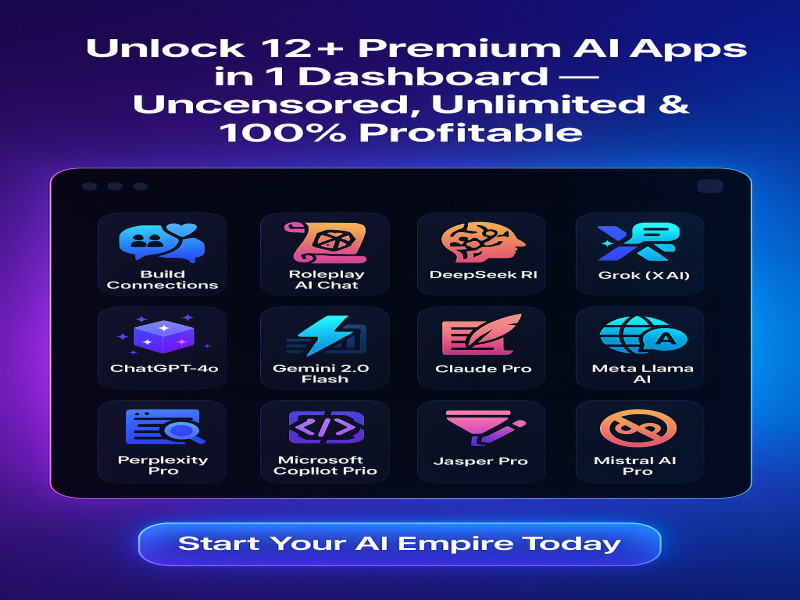
Launch Your Own AI Subscription Business Powered by ChatGPT-4o, Claude, Grok, Gemini, Jasper & More — All Without Paying a Dime in Monthly Fees.
Start Your AI Empire Today
Stop wasting thousands per year on individual tools like ChatGPT, Jasper, Claude, and Copilot.
Tired of restrictions, filters, or politically correct content? Get full control.

No more logging into multiple accounts. Manage everything from one clean dashboard.

Why rent access when you can own and sell access to your own AI subscription product?
Access ChatGPT-4o, Claude, Copilot, Jasper, Grok & more in a single dashboard
Pay once and access forever — saving you over $12,717/year
Ask anything, explore everything — including NSFW and adult AI chat features
Start your own AI subscription SaaS – charge users whatever you want
Create and sell content, apps, chats, and more without restrictions
Newbie-friendly interface, live support & AI-driven guidance built in
Side Hustler
I built my own AI subscription service and made $729 in the first week. This platform is a game changer!
Digital Marketer
I was spending $800/month on 5 different AI tools. Now I get all of them — uncensored — in one place. Love it!
AI Consultant
Finally a platform that respects freedom of speech and gives me full commercial control. Highly recommended.
In conclusion, the Equifax fraud alert is a fundamental tool for modern financial self-defense. It balances the need for credit accessibility with the imperative of identity protection. As data breaches become an inevitability rather than a possibility, the active management of one's credit presence—starting with a simple alert—represents a critical shift toward consumer empowerment and systemic accountability in the digital age. If you'd like to dive deeper into credit security: Comparison of versus fraud alerts .
Furthermore, the legal framework supporting these alerts—primarily the Fair Credit Reporting Act (FCRA)—ensures that the system is accessible. One of the most efficient aspects of the process is the "one-call" rule. When a consumer places a fraud alert with Equifax, the bureau is required by law to notify the other two major bureaus, Experian and TransUnion. This interconnectedness ensures a comprehensive shield without requiring the consumer to navigate three separate bureaucratic hurdles. fraud alert equifax
At its core, a fraud alert is a notification added to a consumer's credit file. When a business sees this alert during a credit check, it is legally required to take reasonable steps to ensure the person applying for credit is truly the consumer. This usually involves calling the consumer at a pre-provided phone number. Unlike a credit freeze, which locks the file entirely and prevents any access, a fraud alert allows the credit market to remain fluid. It serves as a middle ground—permitting legitimate financial activity while installing a digital "tripwire" against identity thieves. In conclusion, the Equifax fraud alert is a
However, the efficacy of an Equifax fraud alert relies heavily on corporate compliance. The system is only as strong as the lender's diligence in following the verification prompts. While it provides a significant deterrent, it does not offer the absolute "lock" that a credit freeze does. This distinction is crucial for consumers to understand; a fraud alert is a warning, whereas a freeze is a barrier. If you'd like to dive deeper into credit
An Equifax fraud alert is a powerful, free protective layer that forces lenders to verify your identity before opening new credit accounts in your name. By placing this alert on your Equifax credit report, you create a vital checkpoint in the financial ecosystem, shifting the burden of verification from the victim to the institution. This essay explores the mechanics, necessity, and broader implications of utilizing Equifax’s fraud alert system in an era of persistent data insecurity.
The necessity of such a tool is underscored by the 2017 Equifax data breach, one of the most significant in history, which exposed the sensitive personal data of nearly 150 million Americans. In the wake of this event, the fraud alert transitioned from a niche security feature to a mainstream necessity. Equifax offers three primary types: the initial one-year alert, the seven-year extended alert for confirmed victims of identity theft, and the active-duty military alert. These options reflect the varying levels of risk individuals face, acknowledging that security is not a one-size-fits-all solution.
Steps to file an for an extended alert. How to manage alerts via the Equifax online portal .
Join thousands who have already taken the next step toward success.
Start Your AI Empire Today